Most Salem tree removals need no permit at all. A specific and knowable set do — and because ash grows along water, ash trees land in that set more often than most species.
Call (971) 518-3780On private property in Salem, a permit is required to remove any tree 30 inches or more in diameter at breast height — except tree of heaven, empress tree, black cottonwood and black locust, which are exempt at any size — plus Oregon white oaks 20 inches and up, trees within a riparian corridor, roughly 50 feet of a waterway, and all street trees in the planter strip regardless of size. Normal pruning on private property does not require a permit. Ash is not on the exempt list, and because Oregon ash is a streamside species, a substantial share of Salem ash trees fall under the riparian rule. Call (971) 518-3780 and the requirement gets checked before anything is scheduled.
Measure the trunk at about four and a half feet up and tell us roughly how far it sits from the nearest creek, ditch or river. That is usually enough to know. Call (971) 518-3780.
Salem's tree regulations live in the Salem Revised Code — Chapter 86 covers trees and vegetation, with related provisions in Chapters 807 and 808. Four categories require a permit:
| Category | Threshold | Notes |
|---|---|---|
| Any species on private property | 30 in. diameter at breast height or more | Exempt at any size: tree of heaven, empress tree, black cottonwood, black locust |
| Oregon white oak | 20 in. DBH or more | Lower threshold than other species |
| Riparian corridor trees | Any size within the corridor | Roughly 50 feet of a waterway — where most Salem ash grows |
| Street trees | Any size | Trees in the planter strip between sidewalk and curb; pruning rules apply too |
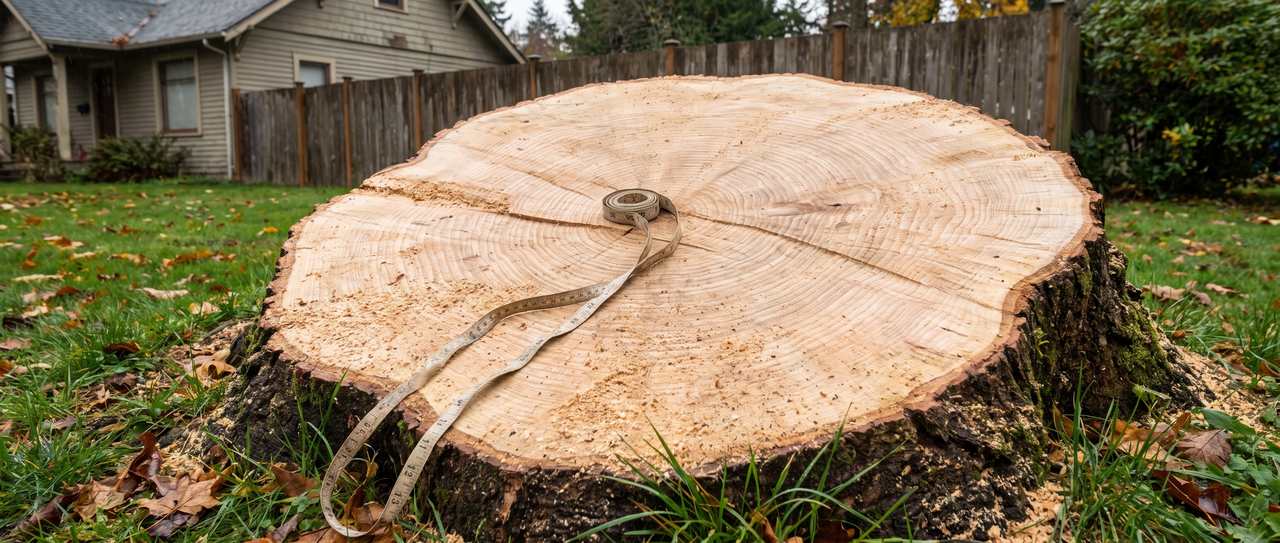
Diameter at breast height means the trunk diameter measured about four and a half feet above the ground — a tape around the trunk divided by 3.14 gets you there. Normal pruning of a private tree is exempt. These are the current rules as published by the City of Salem; verify with the City's urban forestry staff for your specific property, since codes do change.
Oregon ash, Fraxinus latifolia, is the long-term dominant tree of riparian areas west of the Cascades — slow streams, poorly drained ground and seasonally flooded bottomland. In Salem that means the ash population is concentrated exactly where the riparian corridor rules apply: along the Willamette, Mill Creek, Pringle Creek, Shelton Ditch and Claggett Creek, and along the drainage ditches that thread through older neighborhoods.
So while a mid-size ash tree in the middle of a subdivision lot is often unregulated, the same size ash fifty feet from a creek is a permit conversation. It is worth establishing which one you have before you get attached to a schedule — particularly if the ash tree is dead and you would rather not spend a winter waiting.
Oregon does license tree work, which is not true everywhere. Commercial tree care here operates under a Landscape Contractors Board (LCB) license or a Construction Contractors Board (CCB) license — planting work specifically requires LCB. Since 2021 Oregon has also had an LCB Arborist License Phase, which requires ISA Certified Arborist credentials along with experience and an exam. Local convention is to display the license number; Salem outfits commonly show a CCB number on their materials.
Practically, that gives you a real thing to check before hiring anyone for an ash tree: ask for the license number, and ask whether an ISA Certified Arborist is involved when the question is treatment rather than removal. Every provider we connect callers with is an independent, licensed and insured local company.
Two measurements and a free estimate — and the permit handled as part of the job if it turns out you need one.
(971) 518-3780It depends entirely on the city, because Oregon leaves tree regulation to local government. In Salem, a permit is required on private property for any tree 30 inches or more in diameter at breast height, for Oregon white oaks 20 inches and up, for trees within a riparian corridor of roughly 50 feet from a waterway, and for every street tree in the planter strip. Below those thresholds and outside those areas, no permit is needed.
Thirty inches diameter at breast height for most species, with four exceptions that are exempt at any size: tree of heaven, empress tree, black cottonwood and black locust. Oregon white oak has a lower threshold of 20 inches. Ash is not exempt, so a large ash tree needs a permit like anything else — and because ash grows along water, many Salem ash also fall under the riparian rule.
Yes — always, regardless of size or species. Street trees are the ones in the planter strip between the sidewalk and the curb, and the city regulates them separately from trees inside your yard. Pruning a street tree also has its own rules.
Normal pruning of a tree on private property does not require a permit in Salem. The permit requirements apply to removal. Street trees are the exception to watch, since they carry their own pruning standards.
The contractor normally handles it, and that is the right way round: they have the measurements, they know the code sections, and they are the ones scheduling around the approval. Make sure the permit is written into the quote so there is no argument about it later.
Removing a regulated tree without a permit is a code violation and can carry penalties and replacement requirements. It is not worth the risk on a large ash tree, and it is exactly the sort of thing that surfaces later when a property changes hands. Confirm the requirement before the saw comes out — the City of Salem's urban forestry staff will tell you.