Treatment protects a healthy ash tree. It does not cure a dying one, and it never stops being a bill. Here is the math on both sides, with the Salem numbers.
Call (971) 518-3780Emerald ash borer treatment in the Salem area means emamectin benzoate injected into the trunk, roughly $7 to $16 per inch of trunk diameter, repeated every two years, applied mid-May to early June. On a 24-inch ash tree that is about $85 to $190 a year, indefinitely. It is worth paying for on a structurally sound, high-value ash tree that has lost less than about 30 to 50 percent of its canopy. It is not worth paying for on an ash under about 10 inches through the trunk, and it cannot rescue an ash tree that is already well into decline. Call (971) 518-3780 and we will tell you which one you have.
Two measurements settle most of it — trunk diameter and how much canopy is already gone. We will give you the annual treatment number and the one-time removal number side by side. Call (971) 518-3780.
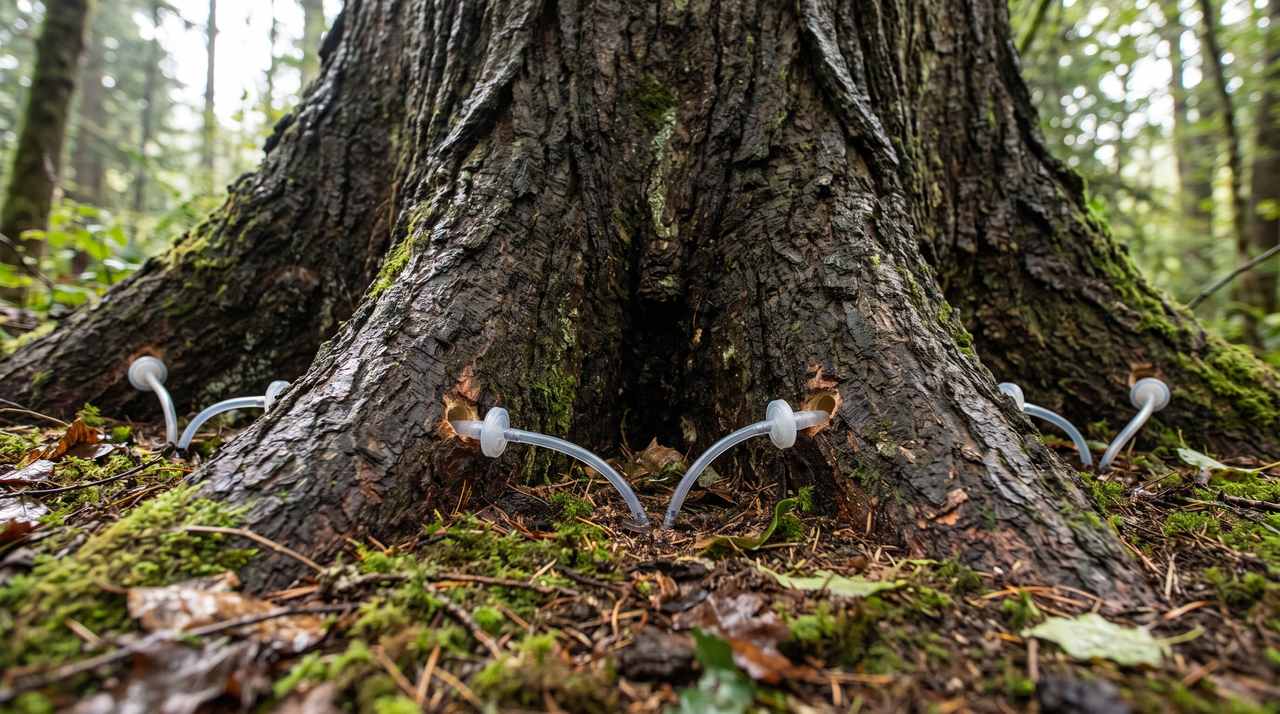
The treatment that works against emerald ash borer is emamectin benzoate delivered by trunk injection — small ports drilled at the root flare, the product pushed directly into the tree's vascular system, then distributed up through the canopy as the ash tree moves water. Soil drenches and sprays exist and are meaningfully less reliable on a large ash tree; injection is what the research supports and what Oregon Department of Forestry guidance describes.
Long-term university data — Purdue's decade-plus trials being the best known — puts effective protection at roughly two to three years per application. That is where the standard two-year cycle comes from. Timing matters: injections go in mid-May into early June in this valley, once the ash tree has leafed out and is actively transpiring. 2026 has been an early emergence year in Oregon, so it is a conversation to have in April, not in June.
The part that gets glossed over in sales conversations: protection lapses when the cycle stops. There is no finish line, no immunity, no point at which the ash tree is cured. As long as emerald ash borer is present in the Willamette Valley — and it is now permanently established here — a treated ash tree is a treated ash tree only while you keep treating it.
Screening candidates honestly saves people a lot of money. A reasonable yes looks like this:
Take a 24-inch ash tree in a Salem back yard. Treatment runs roughly $170 to $380 every two years — call it $85 to $190 a year, with no end date. Removing the same ash tree while it is alive might run $1,400 to $2,200, plus a few hundred for the stump. On those numbers, somewhere around year eight to fifteen the treatment has cost more than the removal would have, and it keeps going.
That math is not an argument against treatment. It is an argument for being clear-eyed: people who treat an ash tree are usually buying the tree itself, not saving money. If the ash tree is not worth that to you, removing it now — while it is alive and the removal is conventional — is the cheaper and simpler path. See the cost page for the removal side and the dead ash page for what waiting adds.
Stated plainly, because it is the most misrepresented thing in this niche:
What it can do is keep a large, healthy, valuable ash tree alive through an infestation that will otherwise kill it — which, for the right tree, is worth every dollar.
Annual treatment cost and one-time removal cost for your specific ash tree, from someone who does not care which one you choose.
(971) 518-3780Trunk injection with emamectin benzoate typically runs about $7 to $16 per inch of trunk diameter measured at breast height, on a two-year cycle. A 24-inch ash tree therefore costs roughly $170 to $380 per treatment, or about $85 to $190 a year averaged out. The cost repeats for as long as you want the ash tree protected.
Emamectin benzoate injections protect for roughly two to three years per application, which is why the standard cycle is every two years. Protection is not permanent and it is not cumulative — when the injections stop, the ash tree becomes vulnerable again.
Mid-May into early June in the Willamette Valley, once the tree has leafed out and is actively moving water, so the product distributes through the canopy. Treating outside that window gives poorer uptake. 2026 has been an early adult-emergence year in Oregon, so timing conversations are worth having before May rather than during it.
Generally yes if it is structurally sound, valuable where it stands, and has lost less than about 30 to 50 percent of its canopy. Generally no if it is under roughly 10 inches through the trunk — replanting costs less than a lifetime of injections — or if decline is already advanced, where treatment is paying to slow something that is finishing anyway.
No. Treatment protects an ash tree that is still largely healthy; it does not reverse damage that has already been done. Girdled tissue does not regrow, and a canopy that is half gone does not come back. Anyone who tells you an injection will bring a badly declining ash tree back is selling you something.
Over a long enough horizon, removal is almost always cheaper — treatment is a permanent subscription and removal is a one-time cost. Treatment wins when the ash tree itself is worth more than the money: shade over a house that would otherwise cook in August, a mature canopy that took sixty years to grow, or a tree whose removal would be brutally expensive because of what stands under it.