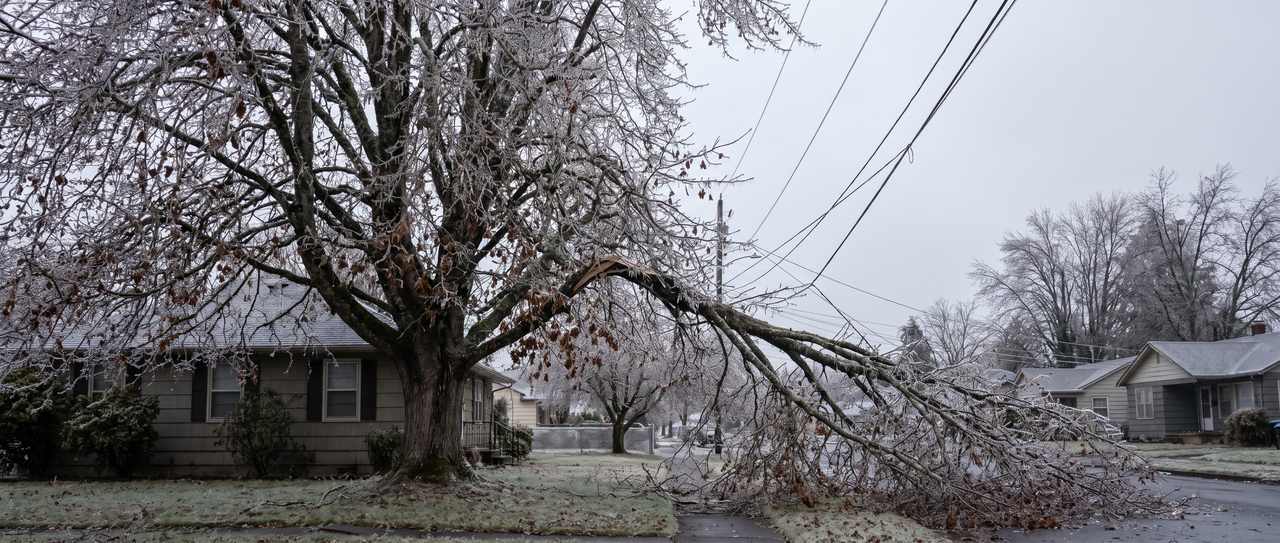
One February night in 2021 took 17.6 percent of Salem’s canopy. Emergency response when a tree is already down — and hazard assessment before the next one.
Call (971) 518-3780Stay clear of it, keep people and vehicles away, and do not cut anything — a tree resting on a roof, a fence, a vehicle or another tree is under load, and cutting into it releases that load in a direction that is not obvious from the ground. If a power line is involved, treat it as live and call the utility first. Then call (971) 518-3780 and describe what is touching what: species and rough size, what it landed on, and whether anything is still standing over it.
Emergency work gets triaged by what is at risk. Non-urgent assessments get scheduled — and fall is the right time to book one on a dead ash tree. Call (971) 518-3780.
The Willamette Valley gets a specific and destructive kind of winter weather: freezing rain that glazes every branch and multiplies its weight. On February 12, 2021, one such event cost Salem an estimated 17.6 percent of its tree canopy — more than a thousand acres of canopy, measured between an August 2020 and May 2021 comparison. Roughly 1,200 city trees were leveled and over 5,000 damaged. About 100,000 Marion County customers lost power. Crews were clearing debris for months. In January 2024 another ice event moved through the valley.
This is not a rare event to be planned around once a generation. It is a recurring feature of the climate here, and it is the reason tree condition in Salem is a seasonal safety question rather than a landscaping preference.
Add emerald ash borer to that picture and the risk sharpens. An ash tree weakened or killed by the beetle dries out and goes brittle, and brittle wood does not flex under an ice load — it shatters. A healthy tree gives you cracking, sagging, a limb that hangs before it drops. Compromised ash frequently gives you none of that.
What that means for a Salem homeowner: a dead or badly declining ash tree standing over a roof, a driveway, a fence line or a power service is not a spring project. It is the tree most likely to fail in the next ice event, on the night when every crew in Marion County is already committed. Handling it in September is a scheduled removal at a scheduled price. Handling it in February is an emergency call-out with a tree already on something. More on that gap: dead ash tree removal.
Most of what an assessment finds is either "fine" or "prune this one limb." The value is in the small number of cases where the answer is that a tree needs to come down before winter — and in Salem right now, those cases are disproportionately ash.
Salem's post-storm pattern is predictable: every crew in the county is booked, the phones do not stop, and out-of-area outfits show up looking for cash work. A few things worth holding onto in that environment — get the license number, get the quote in writing before work starts, be wary of anyone requiring a large cash deposit up front, and remember that in Marion County ash wood and chips stay inside the emerald ash borer quarantine zone rather than leaving on a trailer.
A free pre-season assessment finds the dead ash and the hangers now, while it is still a scheduled job. Salem, Keizer, Silverton, Woodburn and Stayton.
(971) 518-3780Yes — trees down on a house, a car, a fence or across a driveway, and trees hung up in other trees or leaning on a structure. Describe what is touching what when you call, stay clear of it, and do not cut anything yourself. A tree under load behaves in ways that are not visible from the ground.
Bad enough to reshape the urban canopy in one night. The freezing-rain event of February 12, 2021 cost Salem an estimated 17.6 percent of its tree canopy — over a thousand acres. Roughly 1,200 city trees were leveled and more than 5,000 damaged, and about 100,000 Marion County customers lost power. January 2024 brought another ice event.
Because ash killed or weakened by emerald ash borer goes brittle. Ice adds enormous weight to every twig, and where a healthy tree bends and sheds the load, brittle ash wood shatters. A wave of dying ash arriving in a valley that ices most winters is a predictable combination, which is why pre-season hazard assessment on ash trees is worth doing in the fall.
Ask your carrier — that is genuinely their answer to give, and policies differ. What is worth knowing going in is that coverage often depends on what the tree hit and on whether the tree was visibly dead beforehand, which is another argument for dealing with a known-dead ash tree on your own schedule.
Yes, and fall is the right time. A pre-season walk-through identifies dead ash, hangers left in canopies from the last blow, and limbs over the roof or the driveway — the things that turn into emergency calls in February. Scheduled work in October is cheaper than emergency work in January by a wide margin.